Open Source MBSE Tools for Automotive Engineering: A Practical Guide

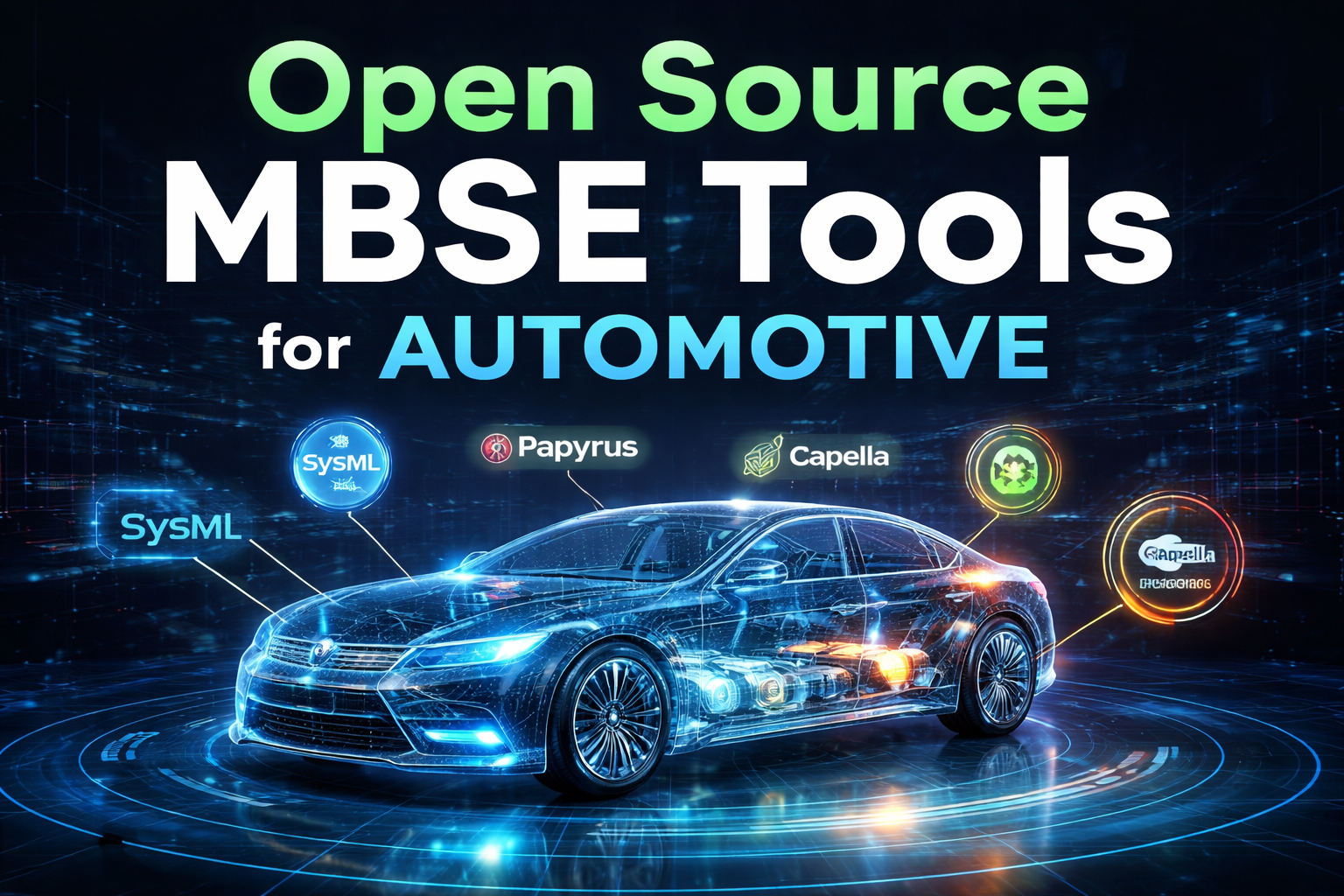
How open source tools can influence automotive industry in these challenging times.
Introduction
Welcome to MBSE Explained. Model-Based Systems Engineering (MBSE) has become a cornerstone of modern automotive and EV development—helping teams manage complexity across software, hardware, safety, and verification. Traditionally, MBSE in automotive has been dominated by expensive proprietary tools, long licensing cycles, and vendor lock-in.
However, the ecosystem is changing. Open source MBSE tools have matured significantly in recent years, offering credible alternatives for system modeling, architecture definition, simulation, and traceability. For an industry under pressure—from electrification costs to shrinking margins—this shift is not just technical, but strategic.
In this article, I’ll walk through the most relevant open source MBSE tools, explain why they are good, and then zoom out to show why switching to open source MBSE is a real opportunity for the automotive industry right now. This perspective is based on hands-on experience in model-based embedded software and systems architecture across automotive projects.
Why Open Source MBSE Matters
Open source MBSE tools offer several structural advantages:
- Transparency: You can inspect metamodels, profiles, and transformations.
- Extensibility: Tools can be adapted to company-specific processes.
- Cost control: No per-seat licensing limits experimentation and scaling.
- Ecosystem-driven innovation: Features evolve based on real engineering needs.
For automotive systems—where long lifecycles and customization are the norm—these benefits are especially valuable.
Key Open Source MBSE Tools
Eclipse Papyrus
What it is: An Eclipse-based modeling environment supporting UML and SysML.
Why it’s good:
- Strong SysML 1.x support for system structure, behavior, and requirements
- Highly extensible via Eclipse plugins
- Well-suited for custom automotive profiles (e.g., function nets, variants)
- Backed by a large industrial and academic community
Papyrus is often the first serious open source alternative to proprietary SysML tools.
Capella (Arcadia Method)
What it is: An open source systems engineering tool built around the Arcadia methodology.
Why it’s good:
- Clear separation of operational, system, logical, and physical architecture
- Excellent for early vehicle architecture and E/E systems
- Strong traceability across abstraction levels
- Method-driven, which helps organizations new to MBSE
Capella is particularly effective for vehicle-level architecture and platform design.
Modelio (Open Source Core)
What it is: A modeling tool with an open source core and optional commercial extensions.
Why it’s good:
- UML and SysML support with a clean UI
- Java-based and scriptable
- Easier onboarding compared to heavier tools
- Good balance between usability and modeling power
Modelio works well for teams transitioning gradually into MBSE.
SysML v2 Pilot Implementation (OMG)
What it is: The official open source reference implementation for SysML v2.
Why it’s good:
- Represents the future of MBSE modeling standards
- Textual-first modeling improves version control and automation
- Better semantics for software-heavy automotive systems
- Ideal for toolchain integration (CI/CD, analysis, simulation)
This is especially relevant for software-defined vehicles.
OpenModelica
What it is: An open source modeling and simulation environment based on Modelica.
Why it’s good:
- Excellent for multi-domain simulation (thermal, electrical, mechanical)
- Commonly used for powertrain, battery, and converter systems
- Supports FMI/FMU for co-simulation
- Complements SysML-based architecture models
OpenModelica bridges MBSE architecture and physical behavior.
SysON (SysML v2–Native MBSE Tool)
SysON is an open source MBSE tool built natively around SysML v2, making it a strong fit within the evolving open source MBSE ecosystem described in this document. Unlike classic diagram-driven SysML 1.x tools, SysON follows a textual-first and semantic-centric modeling approach, which aligns well with modern automotive development practices such as version control, automation, and continuous integration.
For automotive and EV programs increasingly shaped by software-defined vehicle (SDV) architectures, SysON enables more precise system definitions, better traceability, and easier integration with downstream analysis and tooling. Its open source nature allows organizations to experiment with SysML v2 concepts early, adapt the tool to internal workflows, and avoid long-term vendor lock-in. As the industry transitions toward more software-heavy and model-driven development, SysON fits naturally as a forward-looking complement to established open source tools like Papyrus and Capella.
PlantUML (Text-Based Modeling)
What it is: A lightweight, text-based diagramming tool.
Why it’s good:
- Easy integration with Git and documentation
- Ideal for architecture communication
- Low entry barrier for software-heavy teams
- Useful for requirements and interface diagrams
While not a full MBSE tool, it fits well into modern workflows.
Why Open Source Is a Strategic Opportunity for Automotive Right Now
The automotive industry is under real pressure: electrification costs, delayed software platforms, shrinking margins, and global competition. In this environment, open source MBSE is not about saving license fees—it’s about survival and adaptability.
Open source enables:
- Faster experimentation with new E/E architectures
- Reduced dependency on a single vendor’s roadmap
- Internal tool competence, not outsourced know-how
- Better alignment between systems, software, and DevOps
For EV and SDV programs especially, open source MBSE aligns naturally with software-defined, automation-driven development. Companies that invest now can build leaner toolchains, retain engineering knowledge in-house, and react faster to market changes.
This is a rare moment where technical and economic incentives point in the same direction.
When to Be Careful
Open source is not magic. Automotive teams must still consider:
- Tool qualification for ISO 26262
- Process definition and governance
- Internal MBSE skill development
The opportunity lies in owning the toolchain, not just adopting it.
Conclusion
Open source MBSE tools like Papyrus, Capella, SysML v2 implementations, and OpenModelica are no longer experimental—they are viable, powerful, and strategically relevant. For an automotive industry navigating difficult times, they offer a path toward lower costs, higher agility, and deeper engineering ownership.
At MBSE Explained, our mission is to simplify systems for smarter EVs—and understanding open source MBSE is a key part of that journey.
What tools have you tried, and where do you see the biggest obstacles? Share your thoughts below.